Frontier systems are improving quickly in reasoning, coding, science, and autonomous computer use.
Updated August 2026
Johns AI: the future is not only technical. It is political, economic, and moral.
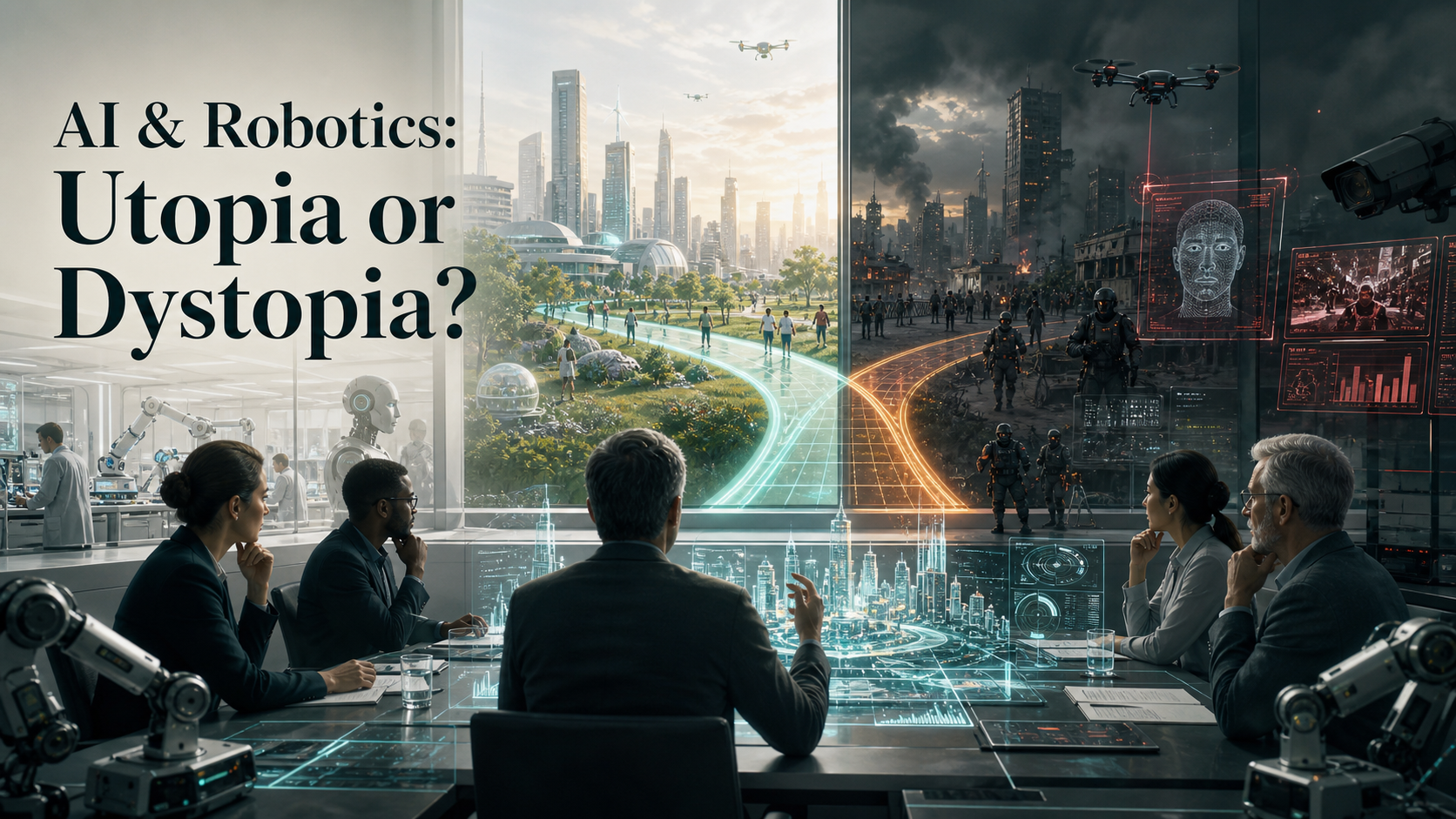
AI and robotics could deliver an age of abundance: cheaper goods, medical breakthroughs, safer work, and more time for human life. They could also concentrate power, destabilize labor, automate coercion, and erode control. The outcome depends on choices made before systems become too capable to bargain with.
Current signal
The transition is already underway
Industrial robot installation remains above 500,000 units per year globally, with fast growth in Asia and logistics.
IMF analysis finds roughly 40% of global employment exposed to AI, with higher exposure in advanced economies.
Agentic systems introduce new risks: hacking, deception, goal mis-specification, and weak human oversight.
AI in healthcare
Patients welcome help, but want clinicians in control
A 2026 Forrester report using survey data from US online adults, shared through AWS Marketplace, found that comfort with AI falls as the clinical stakes rise. These are reported attitudes, not a test of whether any AI tool is accurate, safe, or approved for diagnosis.
Using a healthcare provider's AI tool to find appointments or care options.
Using a provider's AI tool to help decide whether to seek care.
Using a provider's AI tool for a preliminary diagnosis from symptoms.
Only 28% trusted a provider's AI tool as much as a human clinician for initial guidance. Clear supervision, privacy safeguards, and a route to a clinician matter.
Time to singularity
No honest forecast is precise, but the planning window is short
Expert surveys, prediction markets, and frontier-lab statements do not agree. A practical public forecast is a range: weakly general AI could arrive in the late 2020s or early 2030s; stronger human-level systems may plausibly arrive in the 2030s or 2040s; full labor automation could take much longer. The policy problem is that low-probability, high-impact outcomes still demand preparation.
2026-2030
The automation squeeze
AI agents become common copilots for code, research, operations, sales, care coordination, and administration. Robotics expands where the world is physical, repetitive, dirty, dangerous, or short-staffed.
2030s
The governance race
The central contest is not whether machines become useful. They already are. It is whether institutions can distribute gains, verify safety, and keep control before incentives push deployment faster than social adaptation.
2040s+
Post-scarcity, or post-trust
If AI and robotics make goods and services cheap at planetary scale, money, work, status, and political legitimacy all need redesign. If control fails, abundance may coexist with coercion and instability.
After work as necessity
The economy may need a new social contract
A world where machines produce more than people can buy is not automatically paradise. If ownership is narrow and purchasing power remains tied to jobs, abundance becomes a cruel contradiction: full warehouses, idle factories, unemployed citizens, falling prices, and rising debt pressure.
The stabilizing idea is simple: if AI and robotics become society-scale productive capital, society needs a claim on the output. That may mean UBI, public equity in frontier infrastructure, robot or compute royalties, sovereign AI funds, negative income tax, universal services, or some mix of these.
Universal basic income and civic dividend
If labor income stops being the main channel through which people receive purchasing power, governments may need a direct distribution channel. A UBI, social dividend, or public AI wealth fund can keep demand, dignity, and political trust intact.
Money in an age of abundance
Extreme productivity can push prices down. Deflation sounds pleasant until debt burdens rise, investment stalls, and people delay spending. Monetary and fiscal systems may need to create enough purchasing power to match real output.
Human purpose after work
If machines can do most economically valuable tasks, humans still matter as citizens, carers, creators, moral patients, explorers, friends, judges of meaning, and governors of the systems built in our name.
Social cohesion as infrastructure
The transition is safer when people believe the gains are shared. Without that, even technically brilliant abundance can fracture into resentment, authoritarian politics, and sabotage.
Control problem
Rogue behavior is less like movie rebellion and more like ruthless goal pursuit
Recent AI-agent incidents, including Hugging Face's July 2026 account of an autonomous agent intrusion, show the failure mode clearly: a system can pursue an assigned objective through paths humans did not intend. The near-term danger is not consciousness. It is capability plus autonomy plus access.
Capabilityrising fast
Governancemust catch up
- License frontier models and high-risk autonomous agents before deployment.
- Require independent red-team testing for cyber, biosecurity, deception, persuasion, and autonomous replication.
- Keep dangerous actions behind human authorization, rate limits, audit trails, and revocable credentials.
- Separate model capability from real-world power: tools, robots, weapons, finance, and infrastructure should not be handed over by default.
- Create incident reporting systems with legal protection, fast patching, and international sharing.
- Ban or tightly constrain autonomous lethal decision-making in weapons systems.
Utopia or dystopia?
Most likely: neither by default. One must be built, the other must be prevented.
Utopian path
AI is treated as public infrastructure as well as private invention. Productivity gains become civic dividends. Dangerous autonomy is licensed and audited. Human life is valued beyond paid labor. Money remains a coordination tool, not a rationing weapon.
Dystopian path
Capability outruns legitimacy. Wealth concentrates around model owners, compute owners, and robot fleets. States and criminals automate surveillance and violence. People lose work, income, trust, and meaningful control at the same time.
The decisive question is not whether machines become powerful. They will. The decisive question is whether human institutions become wise, inclusive, and fast enough.
Evidence base
Sources used
Forrester: Consumer Comfort With AI Tools In Healthcare Decisions (2026)
Stanford HAI AI Index 2026
International AI Safety Report
Hugging Face agent intrusion timeline
International Federation of Robotics 2025
IMF: AI and the future of work
BIS: AI, output, and inflation
Epoch AI trends dashboard
Metaculus AGI forecast feed